Showing posts with label Marvel Super Heroes. Show all posts

Sunday, December 19, 2021

Rejection letter from TSR

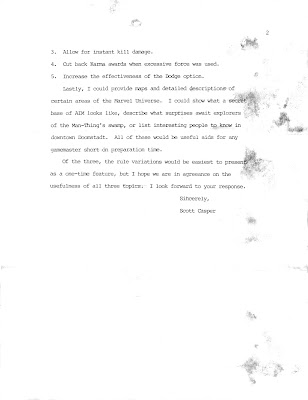
 My first and only time being published in Dragon magazine was "Treasure Trove of Tomes" from Dragon #253, of which I am still immensely proud. But it was not my first attempt to get published therein. I believe that would have been this 1994 letter suggesting a series of Marvel Super Heroes related articles. 23-year old me didn't understand that the reason Dragon had stopped publishing MSH articles was because they didn't have the license for it anymore, as Dale Donovan quickly explained to me in that corner note, rather than enclosing an entire rejection letter in the Self-Addressed Stamped Envelope we had to use back in the before-email times.


Thursday, August 2, 2018

My Four Landmark Campaigns

It occurred to me today that I've been a RPG gamer for 36 non-stop years now. GenCon, a four-day gaming convention, is going on right now. If I had my own four-day gaming convention, each day dedicated to nine years of the time I've been a gamer, what games would be played on each day?

My first nine years were 1982-1991. During this time, campaign play was almost unheard of in our gaming community until 1988, with most of us only played one-off published modules.  My first attempt at a campaign in 1990 was really just the Fate of Istus super-module (with some Dungeon magazine filler stringing Rookroost and Rel Mord together) -- and it was not until 1991 when I started my first ambitious campaigns, the City of Greyhawk (AD&D 1st ed.) campaign and the Wimpy Tales (Marvel Super Heroes) campaign. Neither was very long (the City of Greyhawk campaign never saw anyone rise past 4th level), but they were elaborate in a way I've seldom had time to duplicate since.

The Wimpy Tales campaign (for at least the first two sessions) had their own comic book covers I drew. It avoided the pitfalls of the MSH rules for higher-powered characters by keeping everything, well, wimpy. It studiously clung to comic book continuity, while its lighthearted tone (until the Maggia scenario that killed the campaign) made it accessible to players who didn't read the comic books.

But even more ambitious was the City of Greyhawk campaign. Though the meat of the campaign was the City of Greyhawk boxed set combined with the adventure super-module Greyhawk Ruins, and a smattering of Dungeon magazine offerings for side quests, what made this campaign special was that it was really five different solo campaigns, each with its own cast of characters and ongoing plots, and the player-characters only crossed over and teamed up as needed. We had some pairings on some adventures, and a single case when three players all teamed up together. There were ambitious storylines, like the wild magic surge/time travel adventure that allowed Perrin the elven thief to confront the killer of his parents, too late to save them. I have never had the time to achieve that level of complexity since.

My next nine years were 1991-2000.  During this time I ran Forgettable Realms, a Wimpy Tales-like campaign using D&D; started and aborted an ambitious Pendragon campaign; but my greatest achievement -- my most successful campaign ever -- was the South Province campaign (AD&D 1st ed.) that I started during this stretch. Running from 1997 to 2005 (eight years, though I have long mistakenly remembered it lasting ten), South Province had 14 players over the course of the campaign, had one character reach 10th level, and a compelling story arc that ended with the heroes confronting and besting the evil herzog of the province. In some ways it was City of Greyhawk-lite -- there were character-specific supporting cast and subplots, and characters sometimes spent weeks of game time separated on different tasks, but it was understood that everyone was part of a group (the Band of the Grinning Gargoyle, marking one of the only times my players ever chose a group name) and would adventure together.

Every character died at least once. A TPK was foiled once with a Wish spell, while in my most ambitious plotline I intentionally killed off every character that had ever been a member of the Band of the Grinning Gargoyle so that they could be brought back to life as prisoners in a duplicate of the Tomb of Horrors created by Acererak's spurned wife! For much of the campaign, I had time to keep up a running newsletter (The Prymptown Courier) that included write-ups of what was happening in sessions, along with interviews with NPCs and other goodies. I even found time to create an original three-level dungeon (that wrapped around one published dungeon level) that they kept coming back to, though the rest of the adventures were various published modules, heavily modified. We played through a lot of the classics like G1 Steading of the Hill Giant Chief (with ogres instead of hill giants), G2 Glacial Rift of the Frost Giant Jarl (with yeti instead of frost giants), and Tegel Manor.

My next nine years was 2000-2009.  After South Province wrapped up in 2005 I floundered directionless and largely player-less. But I was also moving away from wanting to run D&D as-is. In 2008 I had begun working on Hideouts & Hoodlums, a retroclone that combined the game I wanted to run with golden age comic book adventures, and in 2009, right at the end of this span of time, I began my first online H&H campaign on rpol.net.

But, before that, I ran my most successful online campaign ever in Yahoo! Clubs, Superland, from 2001 to 2004. Superland was largely freeform, but with a thin veneer of Marvel Super Heroes layered into it to keep combat fair. I had at least 13 players over the course of Superland; some of could not keep up and dropped out quickly, while Captain Comet, Mr. Terrific, and Dr. Eternity were mainstays who formed the foundation of the Crimebusters Club and shaped the course of the campaign. Though City of Greyhawk and South Province had a lot of this built-in, this campaign was more about simulating everyday life in a world of superheroes than it was about them having adventurers -- though that did not stop them from facing the occasional supervillain. The premise was that, in 1955, Disneyland opened, but was incorporated into the City of Anaheim instead of separate from it, and Walt Disney had invited the aging superheroes of the golden age (who were aging in real time) to come live in Disneyland. It was a shared universe setting with a hodgepodge of characters from various comic book publishers all interacting together.

My last set of nine years has been 2009-20018. During this time, I have only run two AD&D campaigns, a live session Garham to Greyhawk campaign (all east and south of the City of Greyhawk, but never reached it before a TPK ended the campaign) and an online Verbobonc campaign (my plan was to run them through the Living Greyhawk tournaments, but we only did the first one and then detoured into stopping the Cult of the Flaming Eye from possessing Dieg Manor from the super-module Fate of Istus, kind of bringing me full circle D&D-wise).

All of my other campaigns in this period have been H&H campaigns. Two also-rans were my Library Campaign, that saw a lot of young people try H&H and saw them choose to move from exploring hideouts in the Midwest to fighting Nazis in Occupied France, and a short-lived JSA campaign online that emulated just All-Star Comics #5, with a lot of wandering encounters added.

My three best campaigns in this period have been three Hideouts & Hoodlums campaigns. First was my Rpol campaign. Like South Province, the goal here was running through heavily modified classic D&D adventures -- Temple of the Frog, Tomb of Horrors, Escape from Astigar's Lair, Expedition to the Barrier Peaks -- but set in 1940. I believe that ran for four years and saw heroes reach 6th level, but rpol.net erased my archive so I can't go back and check anymore.

I'm also proud of the campaign I'm running now. My first ambitious attempt to run a sandbox campaign setting using H&H, the Mount Prospect campaign (also known as Batman and the Golden Age Outsiders) is in its second year, has a steady group of five players, heroes as high as 6th level, and is largely based on the early unpublished D&D works of Rob Kuntz (with a little Len Lakofka's Lendore campaign thrown in).

But my greatest accomplishment during this period were my Blue Box Campaign/Sunday Nights Campaign, using H&H. For the only time ever, I had two independent groups of players who could cross over into each others campaigns, as happened twice. The Blue Box Campaign frustrated my players sometimes because of my ambition, but it was a perfect emulation of the solo and group adventures of the Justice Society of America from All-Star Comics #4-7, mixed with additional comic book adventures and classic modules like Dark Tower. Meanwhile, the Sunday Nights Campaign ran longer, saw heroes rise as high as 8th level, and had adventures like exploring an alternate Norway that had become magically merged with the Wilderlands campaign setting, and explored the Citystate of the Invincible Overlord. They returned to the Americas, where they fought Nazis in Brazil and wound up saving President Roosevelt from an ambush from a magic gate, but accidentally burned down the White House in their grand finale.

So my four landmark campaigns were:
City of Greyhawk
South Province
Superland
Blue Box/Sunday Nights

Saturday, March 4, 2017

Chronology of Events for a Silver Age Marvel Super Heroes Campaign

Many years ago, I tried to run an ambitious, open-ended Marvel Super Heroes campaign set in 1967. What follows are my scheduled events for the first day and a half of campaign time.


Monday, February 23, 2009

New Silver Age Villains Statted for MSH Game

Previously, I had shared about my aborted Silver Age Marvel Super Heroes campaign here. I had, from memory, talked about a character concept I had for the Quickster, but a while ago I was going through some of my old notes and found that I had it backwards. The Quickster wouldn't have moved super-fast -- he made others move super-slow. I had five supervillains statted out for the Silver Age campaign, three of which I didn't even have scheduled for the campaign.

Cosmic Man
F Gd A Ex S Am E Mn R Ex I Gd P Gd H 133 K 34 Res Gd Pop -2
Powers
Body armor: Excellent
Hyper-running: Good
Flight: Excellent
Force bolts: Incredible

Firebug
F Gd A Ty S Ty E Ex R Ty I Ty P Gd H 36 K 20 Res Pr Pop 0
Powers
Fire generation: Remarkable
Fire control: Typical

Killing Machine
F Gd A Ty S Ex E In R Gd I Ex P Fb H 65 K 25 Res Fb Pop -3
Powers
Body armor: Remarkable
.45 machine guns (in forearms): 60 dmg, Remarkable penetration (armor-piercing house rule)
Mini-rocket platforms (shoulder-mounted): 40 dmg, Excellent penetration (1/2-dmg on misses without cover)
Mini-flame thrower (finger-mounted): 20 dmg

Quickster
F Gd A Gd S Ty E Gd R ty I Ex P Gd H 30 K 30 Res Gd Pop 0
Powers
Inertia-dampening field: Amazing. Subtracts 230 MPH to movement rates around him, divided between targets.

Skulk
F Gd A Gd S Ty E Ex R Gd I Ex P Ex H 38 K 40 Res Gd Pop 0
Powers
Invisibility (psionic): Remarkable
Talents: Bows, Guns, Move silently.

Addenda from 2/25/2009:

I found two more sets of stats for the campaign. I don't think I wound up using these first guys. The "Peacelover" scenario was supposed to give the heroes the moral choice of fighting the protesters or fighting the Man. Had the chosen to stick it to the Man, they would have fought -

Elite Anti-Riot Squad Officers (EARSO)
F Gd A Ty S Gr* E Ex R Ty I Pr P Pr H 44 K 14
Powers
Body armor: Typical.
Flight: Poor speed jetpacks.
Pepper, soapwater sprays: Typical stunning-irritants.
Rubber bullets: Non-lethal Typical damage.

*Great was a rank I had inserted between Good and Excellent and represented 15 pts., or the ability to lift/press 600 lbs.

The most prominent supporting cast NPC superhero I planned on using was actually not a Marvel character at all. Since most Marvel heroes were based in New York, I decided a few DC heroes I really liked (at that time) would be based in the Midwest. I had just recently discovered scanned pages of old Johnny Quick adventures online and so he was my first pick.

Johnny Quick
Real Name: Justin Matthewson Occupation: Professional superhero Origin: Altered human Place of residence: Detroit, Mich. Age: 26 First appeared: 1964
F Gr A Rm S Gr E Ey** R Gr I Gd P Gd H 85 K 35.
Powers
Hyper-running: Astonishing land speed.***

**Extraordinary was an inserted rank between Excellent and Remarkable, equal to 25 pts.
***Astonishing was a rank between Amazing and Monstrous, equal to 60 pts., or 500 MPH.

Sunday, January 18, 2009

The Silver Age Marvel Super Heroes Campaign

Around 1997, I had prepared a lot of material (mainly rules revisions) for a Marvel Super Heroes campaign I called The Silver Age Campaign. Set in Chicago during Marvel Comics' “silver age” -- 1967 specifically – and being a huge fan of Marvel's silver age comics myself, I had high expectations for this campaign...none of which survived the apathy of my four younger friends and our first three sessions. Having just barely missed the '60s myself, I have always viewed that time as a missed opportunity and a time full of amazing happenings and a wonderful spirit. My friends, more divorced from the '60s than I, saw it as a time to mock with derision.

To be fair, I had expected too much from them at the start. Centering the first plot around Vietnam War protests took one of the most divisive moments of the '60s and pushed it right in their faces. If I could do it all over again, I would start them off with a more traditional superheroes vs. supervillains story and then slowly work the time period in on them. Ah, but I was so eager...

The heroes were Winged Archer, sort of a cross between Angel and Hawkeye; Daemon, a weaker Martian Manhunter who uses fire instead of being afraid of it; Prodigy, a psychic; and Swashbuckler, pretty self-evident.

My schedule of plots was as follows:
1) Peace Lover's (new villain, emotion control) demonstrations lead to riots.
2) A doomsday cult worshiping Galactus is manipulated by the Miracle Man.
3) The Circus of Crime decides to make some quick bucks with mundane crimes.
4) Dr. Prometheus (new villain, chimp mad scientist – before Big Bang Comics did it!) starts a hi-tech crime spree.
5) AIM's line of computers come with parts not in the brochure.
6) Dr. Octopus is asked by AIM to deal with the heroes.
7) Puppet Master makes the heroes attack the Fantastic Four.
8) Peace Lover leads demonstrations against the heroes.
9) Radioactive Man tours the Midwest (guest-starring “The Man with the Power” from John Byrne's future run on the FF).
10) Firebug (new villain, similar to Daemon only a mutant instead of an alien) sets Chicago ablaze.
11) Dr. Prometheus starts a gang war with the Giovanni family (The Giovannis were the Chicago branch of the Maggia in my Wimpy Tales campaign).
12) The Wizard and the Sorceress (new villain, female mad scientist) have a reunion.
13) Egghead sends Destroyer and Hijacker to get a microfilm Rick Jones doesn't know he has.
14) Coyote (new villain, the Indian trickster god) comes to Chicago to make trouble.
15) Jack Frost (new villain using Blizzard's old name) intends to hold Chicago for ransom against winter.
16) The Space Men (from Untold Tales of Spider-Man) hope to trick the heroes into revealing AIM's secret base for them. John Jameson guest-stars.
17) Quickster (new villain, like a cross between Quicksilver and the Riddler) goes on crime spree.
18) Heroes in Michigan (Johnny Quick and Dr. Mid-Nite – some of DC's more obscure heroes work there) need help against the Black Pilgrim (new villain, mystic villain).
19) The last Incan priest abducts the heroes, intending to sacrifice them to Zzutak.

Other villains intended to be used: Madame X, Sub-Mariner, Mad Thinker, Paste-Pot Pete/Trapster, Baron Mordo, Eel (recurring), Porcupine (recurring), Plant Man (recurring), Cobra, Electro, Mr. Hyde, Vanisher (recurring), Mysterio, Kraven the Hunter, Beetle, Mastermind (recurring), Unicorn, Melter, Purple Man.

Other heroes intended to be used: Invisible Girl, Human Torch, Mr. Fantastic, Goliath/Yellowjacket, Wasp, Iron Man, X-Men, Daredevil, Captain America, Doctor Strange, Nick Fury, Hawkeye, Black Widow.

Silver Age Campaign Journal (summarizing the actual campaign)

May 17, 1967. Wednesday.

Brian Chalice (Prodigy) was interrupted twice from his painting. The first time, he consoled his maid who was concerned about her son's wild ways. The second time, he got a phone call from his agent who wanted him to meet Peace Lover.

Damian Khalas (Daemon) put in his time at the fire station. After some horsing around, his friend Gary told the tale of the haunted handprint on the firehouse window.

Steven Barnes (Swashbuckler) was behind in his construction work, but being union, was not too concerned about it. He was concerned enough to save his coworker, Harold Price, from a badly-installed elevator.

Brian met with Peace Lover at the Sheraton Hotel and was introduced to three artists. While Brian was impressed with none of their work, he was quite taken with Bridget Riley, one of the artists, and agreed to sponsor her work. A while later, he learned of a peace rally begun by Peace Lover and his followers in Grant Park and went to investigate.

Damian, having a knack for poker, walked away from the game at the firehouse early with $20. He wandered the city, looking for trouble. He encountered three Hispanic youths whom he scared out of committing arson. Later, he was drawn to the commotion of the peace rally and slipped in amongst the protesters.

Sam Morris (Winged Archer) was having a typical day in the antiquarian business when a routine purchase turned into a bidding contest with his rival, Gus Munsey. The encounter ended in a stalemate, with neither acquiring the 16th century tinderbox.

Brian managed to find Bridget at the protest, but could not convince her to leave. Instead, she convinced him to speak to Peace Lover. In his private trailer, Peace Lover delivered a hypnotic oration that compelled Brian to agree to finance the demonstration. Upon leaving the trailer, the two ran into Damian, who was confused by a great many things around him. Peace Lover evaded his questions and devised a diversion for the police so Brian and Bridget could sneak out of the park unobserved.

Damian saw the diversion, protesters throwing things at the police, and decided to stop it with a demonstration of his powers. When the police became interested, however, in him, Damian shape-shifted in order to escape.

Steven, who had been observing the protest from nearby Buckingham Fountain, observed the shape-shifting and confronted Damian. Unable to disprove what Steven saw, Damian decided to reveal his entire background. At Damian's boarding house, he also demonstrated his fire generation, as well as his lack of control when he set his coffeetable on fire. Steven suggested that they could help each other, and left promising to be in touch.

Meanwhile, Sam had closed up his shop, put on his costume, and decided to debut as the Winged Archer. He patrolled the north side on wing and found a home ablaze. Firefighters were already at work, and police at the scene tried to question Winged Archer. He tried to fly in the house, but was scared off by the flames. Finally, he convinced a fireman to give him his hose so he could spray the roof. With the fire out, Archer left his name, and flew off into the night.

Brian brought Bridget to his penthouse. He slept on the couch.

Steven returned to the rally at the same time that Archer first arrived. Thinking Steven looked suspicious, Archer shadowed him, but Steven spotted him and led him to a rooftop to confront him. The two circled each other with weapons drawn, exchanged pointed questions, and then parted.

May 18, 1967. Thursday.

When Brian woke up, his mind was free of Peace Lover's influence. Nevertheless, he gave Bridget $1,000 to buy supplies for the protest. Then, he snuck back into Grant Park and into Peace Lover's empty trailer. Brian had brought the costume with him which he planned to wear as a superhero, and put it on. However, before finding much evidence of wrong-doing, Peace Lover and a tough-looking stranger entered. The stranger drew a revolver from a shoulder holster, and a fierce struggle ensued. Brian was grazed in the shoulder before he sent the stranger flying out the doorway. Meanwhile, Peace Lover had fled out a window and gathered a huge mob of protesters. Brian managed to telekinetically lift Peace Lover out of the crowd. Before he could learn more, Peace Lover convinced the police to arrest him for drug possession. Instead of remaining to answer questions, Brian fled on foot.