Showing posts with label TSR. Show all posts

Sunday, December 19, 2021

Rejection letter from TSR

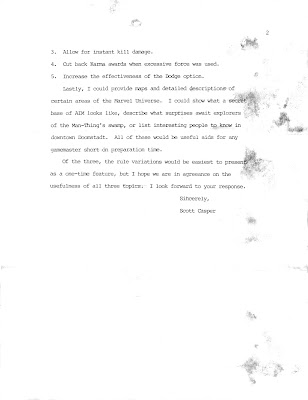
 My first and only time being published in Dragon magazine was "Treasure Trove of Tomes" from Dragon #253, of which I am still immensely proud. But it was not my first attempt to get published therein. I believe that would have been this 1994 letter suggesting a series of Marvel Super Heroes related articles. 23-year old me didn't understand that the reason Dragon had stopped publishing MSH articles was because they didn't have the license for it anymore, as Dale Donovan quickly explained to me in that corner note, rather than enclosing an entire rejection letter in the Self-Addressed Stamped Envelope we had to use back in the before-email times.


Wednesday, March 29, 2017

GaryCon IX Report - part 1

My 2017 GaryCon IX adventure began a day early. I had decided to accept the open invitation of Frank Mentzer to come to Frankenparty, the huge gathering at his Wisconsin home the night before the con. It was a little adventurous just getting there from Chicagoland, as I missed a turn and got lost briefly right around the border, but I soon found my way there by another route.
A lot of people were already there by six o’clock, who all seemed to know each other, so I was feeling pretty shy and ready to hide in a corner when I got inside. Luckily, Carlos Lising was there and spent some time sitting with me and talking about comic books. With his encouragement, I hung around Frank Mentzer’s office, listened to him tell stories, and got to touch Gary Gygax’s desk. I completely botched the treasure hunt, though, even with several people offering me help. Frank and Debbie were such gracious hosts that I would definitely like to go back next year.
The next day was Day 1 of GaryCon.  That morning, I left again from Chicagoland, this time bound for Lake Geneva. A wrong turn took me to Grayslake and I thought I would miss my first event at 10 am, but I made excellent time through Wisconsin thanks to their speed limit of 70 and I made it to the Grand Geneva Resort just 10 minutes late. I did not even have time to pick up my tickets and name tag; I had to slip away in the middle of the session to go get those.
My first event was an AD&D (1st ed) adventure called “A Debt of Honor.” My friend Will Schumacher had recommended the DM and I thought he would be playing with me, but Will had dropped out the week before.  Right away, while looking at the characters available to play, Eli triggered one of my pet peeves --  too much house ruling. When I sign up to play a certain game at a convention, I expect to play that game as-is, not someone else’s modified version of it. But the halfling thief looked unaltered; I gladly accepted it even though, in my experience, thieves tend to be unimportant past low level.


The scenario was decent, though the back story was too hard to figure out.  I was glad for so many traps in it, since it kept my thief relevant. Some of the traps were ingenious, though the placement of them was repetitious. As is sometimes the case with these convention scenarios, it’s the fellow players at the table who made the game special. I graded the event with a B and left the table at 2, thinking this was an encouraging beginning, despite my frantic arrival.


Next, I had a ticket to observe Jim Ward's Celebrity Metamorphosis Alpha event (having failed to secure a player ticket). I explained to him in advance how my plan was to observe just the first half of the game before checking out the exhibit hall. This was my first time observing Jim game mastering and was struck by his natural charisma and charm. I picked up some good ideas from him, like letting the players pick any 10 items they want to carry, and shuffling index cards with players’ names on them instead of having people roll individual initiative.


All was going well after an hour (even for the players - only one character death by then), until I found I had some recycling to throw away. That led to a long quest to find a receptacle marked for recycling that ultimately ended in failure. Later, I was told that the bins with tan bags inside were for recycling, but since no one knew that I found they were always filled with mixed trash. Only in this way did the Grand Geneva Resort let me down all weekend.


Because I had wandered so far afield with an empty and unwanted water bottle, I had found myself too close to the exhibit hall. Now, in just a few hours of being out of service range, my phone was rapidly sucking it's battery dry. I was hoping my friend Carlos would have a compatible charging cord, and knew I would  find him in the hall. This would, surely, just be a brief diversion.


I stopped to say hi to Terry Pavlet - always a pleasure. I soon found Carlos again, sitting with his GaryCon companion, the artist known as Darlene. But Carlos had to leave to go pick up a pizza, and Darlene invited me to sit with her.


Now, I have been on the vendor side of a table before, but never at GaryCon, and never has a celebrity asked me to come sit with him or her anywhere. So I abandoned my stuff back in the boardroom with Jim Ward, just trusting my stuff was safer than the characters in Jim’s game, and stayed with Darlene. I told her my personal story of how I discovered Greyhawk and what gaming was like in my teen years. Then, fearing I was boring, I borrowed a story Terry had just told me a short while earlier (I did credit him with the story and didn't try to pass it off as my own). Luckily, Carlos was on the longest pizza run in world history, so I even got to stay and enjoy watching Darlene chat with other celebrities, like Allen Hammack.

She even left me in charge of the table once! Now, I had met and talked to Darlene 3-4 times by now, but she hardly knew me. I realized, though, that this confidence in me wasn't due to my own charisma. Darlene trusted me because Carlos trusted me, and that's how much she trusted Carlos.


Eventually, Carlos did return with the pizza, but then had to run off to help someone else. So now I got to stay and have pizza with Darlene in his stead. Incidentally, Carlos did not have a compatible charging cord, but I could scarcely care, as full as I was with generously shared pizza slices.


One remaining problem though, was that I lost all power on my phone and had no other timepiece on me, and I did not want to be late for my 6 o’clock game of Swords & Wizardry - so I gathered my things (which had been safe in the boardroom) and moved to my reserved table an hour early.


My Swords & Wizardry game was “Jungle Ruins of Madaro-Shanti”, which I had written for Mythmere Games and was published through Frog God Games when they merged. I had seven players, including a couple who dropped in to play because the guy remembered enjoying my OD&D version of “The Invasion of Arun’Kid” last year. One player was Ryan Thompson, who writes his own S&W material and gifted me a copy. Speaking of copies, Michael Badalato stopped by to drop off copies of S&W Light for everyone. Although I’m sure he meant well, this led to some confusion later, as I was running S&W Complete, but my players kept referring to the S&W Light pamphlets in front of them.


Other than that confusion, the game went great. SPOILERS MAY FOLLOW!  The noise level in the room actually helped me (actually, it was mainly from the rowdy bunch playing Keep on the Borderlands next to us) for a change, because they could not overhear each other’s rumors. This party decided to go with most of the expeditionary force of NPCs the town offers them, and it became a running gag for half the session, putting the jungle guide in danger. We got bogged down a little at the gatehouse because they thought it was important to win the fight with the borsin tribe, though most groups figure out to just run from them. They did succeed in finding all the treasure in the gatehouse, though, which most groups don’t do. They completely ignored the well (most groups at least examine it, but no one has ever figured out the whole well complex). Like everyone else, they always assume there must be something good in the temple ruins -- I should really write a supplement someday for the temple ruins instead of just saying it’s empty or making up something.


The druid spent a little too much time scouting alone in animal form for my liking, leaving the rest of the players waiting, but I understand how it was strategically sound to do so -- it even let them avoid some really dangerous giant spider encounters when they finally got to the palace. By the time we finally got to the palace, they went down into the dungeon right away and were really rushing through that first level, as we were running out of time. We stopped after four hours, with two-thirds of the first dungeon level cleared out, and the players seemed to be very happy.


After that, it was time for me to head home. I needed a good night’s sleep back in Chicagoland before the next day’s exciting adventures!

Monday, August 20, 2007

D&D Campaign/Module Early Development Timeline, 1971-1979

[5/17/2018 update: I decided to go back to this old post and flesh it out a little better.]

The purpose of this post is to share what I know about the development of the material from the early days of Dungeons & Dragons, up through the 1970s, to when they were eventually published adventure modules, and to build a timetable out of it. At one point, this included material that was never published, but that I knew about circa 2007. I know about a lot more know, but can refer readers to better sources for that, like the timeline on the Rob Kuntz Archive DVD.

1971

1. Castle Blackmoor. Dave Arneson’s home campaign centers around Castle Blackmoor and later is released in the Judges Guild accessory The First Fantasy Campaign. The castle had 12 levels of dungeons. A town called Blackmoor, located outside the castle, provided support for the adventurers between expeditions, and also itself served as a backdrop for adventures (such as repelling invaders).

1972

2. Castle Greyhawk. Inspired by Castle Blackmoor, Gary Gygax creates his own home campaign centered around a fantasy castle. The original Castle Greyhawk material has never been published, though details of it crept into the 1990 TSR module Greyhawk Ruins. The castle dungeons grew over time from 10 levels to a sprawling complex with an uncountable number of sub-levels, and even a slide that takes you all the way to the other side of the planet. Though unpublished, many details of the castle have been shared over the years and Allan Grohe has compiled them on his remarkable website.

3. El Raja Key. Rob Kuntz’s campaign, inspired by Castle Greyhawk, and would soon become sort of merged with Castle Greyhawk after the two become co-DMs. Parts of El Raja Key have been released over the years, most famously in the 1984 TSR module Mordenkainen's Fantastic Adventure. Many levels of El Raja Key are included, with original maps and keys, on the Rob Kuntz Archive DVD, though it appears to me that instead of the original keys these reflect a restocking of the dungeon that must have happened circa 1981.

4. City Greyhawk. The first full-sized fantasy city developed for a RPG (Blackmoor only had a town by it). TSR put out an amazing City of Greyhawk boxed set in 1989, but scant details of it bear any similarity to the original co-designed by Gygax and Kuntz. The original version of the city has never seen print, though more details of it can be gleaned from Gygax's Gord the Rogue novels.

5. Lost City of the Elders.  From Rob Kuntz's home campaign. Part of the Lost City is known as the Garden of the Plant Master. Garden of the Plant Master was first published by Creations Unlimited in 1987, then by Kenzer & Company in 2003. The last known time Lost City was publicly run at GaryCon in 2012 and it then had sections allegedly challenging enough for 14th level characters.

6. Castle Glendower? This date is speculation. Glendower was another town in the Blackmoor campaign, this one with a four-level dungeon beneath it. Like Castle Greyhawk, the notes for it were published in The First Fantasy Campaign.

1974

7. Loch Glomen/Lake Gloomey? Again, speculation. Lake Gloomey was a monster-infested area reachable from Blackmoor. Instead of underground dungeon, Glomen had areas above ground, like a mansion, that needed to be cleared out of monsters. Like Blackmoor and Glendower, the notes for Loch Glomen were published in The First Fantasy Campaign.

1975

8. Temple of the Frog.  The scenario was played first in the Blackmoor home campaign, but then was written up (and more than just in note form like the FFC material) and published in the 1975 TSR Supplement, Blackmoor. TSR published a revised and expanded version in 1986, and then was published again by Zeitgeist Games in 2007.

9. Tomb of Horrors. It is unclear if this was written first for Origins I in 1975 as one of the first D&D tournaments, or if it was played in the Greyhawk home campaign first -- but definitely one happened first and then the other. TSR published The Tomb of Horrors first in 1978 and it has been reprinted often since then.

10. The Stalk. An outdoor scenario from Kuntz's home campaign (Kalibruhn, where El Raja Key could be found) for characters of up to 12th level. Kuntz self-published it (as Pied Piper Publishing) in 2007.

1976

11. Escape from Astigar’s Lair (MichiCon V tournament/JG module)
12. Expedition to the Barrier Peaks (Origins II tournament/TSR module)
13. GENCON IX Dungeons (tournaments/JG module)
14. Lost Caverns of Tsojconth (WinterCon V tournament/Metro Detroit Games module/TSR module)
15. Palace of the Vampire Queen (Wee Warriors module)
16. Demonworld (R.K. campaign)
17. Dark Druids (R.K. campaign/Necromancer Games module)
18. Lair of the Pit Fiend (R.K. campaign)

1977

19. Dwarven Glory (WW module)
20. City State of the Invincible Overlord (JG accessory)
21. Tegel Manor (JG module)
22. Modron (JG module)
23. Of Skulls and Scrapfaggot Green (GenCon X tournament/JG module)
24.  Sample dungeon from Holmes ed. D&D Basic Rules

1978

25. Steading of the Hill Giant Chief (TSR module)
26. Glacial Rift of the Frost Giant Jarl (TSR module)
27. Hall of the Fire Giant King (TSR module)
28. Descent Into the Depths of the Earth (TSR module)
29. Shrine of the Kuo-Toa (TSR module)
30. Vault of the Drow (TSR module)
31. Tomb of Horrors (TSR module)
32. The Thieves of Fortress Badabaskor (JG module)
33. Citadel of Fire (JG module)
34. Frontier Forts of Kelnore (JG module)
35. The Dragon Crown (JG module)
36. Quest for the Fazzlewood (WinterCon VII tournament/Metro Detroit Games module/TSR module)

1979

37. The Village of Hommlet (TSR module)
38. White Plume Mountain (TSR module)
39. Pharoah (Day Star Media module/TSR module)
40. Rahasia (DSM module/TSR module)
41. Fortress Ellendar (Fantasy Productions module)
42. Lost Tomoachan: The Hidden Shrine of Lubaatum (Origins V tournament/TSR module)
43. The Ghost Tower of Inverness (WinterCon VIII tournament/TSR module)
44.  Sample dungeon from AD&D Dungeon Master's Guide

5/28/2021 update: Ah, why not? I'll include the complete list, for completeness' sake. Some of the items I don't know why I took off the list, particularly from 1979, though it's possible those were written onto the list after I first made this post.


The Best Role-Playing Games, Year-by-Year

This is some material I’d been working on for titangaming’s column before…you know [The site crashed and disappeared]. Culled from my work on grading my gaming collection, I’ll be talking about the best gaming products I own from each year since the hobby began.

In the beginning, it was all about Dungeons & Dragons. Chainmail, Dungeons & Dragons (specifically, the Men & Magic booklet, the crunchiest of the three), and the Greyhawk Supplement won for consecutive years, not because they’re perfect, but because there was no competition from 1973 through 1975. Each winner was TSR’s major release for that year and, by no coincidence, had all been written or co-written by Gary Gygax. Things went a little differently in 1976. D&D Supplements by different authors were pretty lame and the best product from ‘76 was, surprisingly, Strategic Review #7. This was a particularly solid issue of Dragon Magazine’s predecessor, anticipating the strong showing of another magazine in the years to come.

Advanced Dungeons & Dragons began in 1977 with the Monster Manual and top marks for the following year went to the Players Handbook. To this point, game mechanics ruled. With 1979, however, Module T1, The Village of Hommlet, proved to be better than the Dungeon Masters Guide, companion volume to the two earlier AD&D rulebooks. With the rules for D&D/AD&D well-established, TSR wisely turned its gaze to publishing adventure modules, and it was modules that they did best for the next four years — B2, The Keep on the Borderlands; A3, Assault on the Aerie of the Slave Lords; S4, Lost Caverns of Tsojcanth; and I6, Ravenloft just kept getting better one after another. With only two exceptions, Gary Gygax was the principle author of each book.

By 1984, Gary Gygax was too busy with office politics to write the next best thing. TSR was slowly going into decline, but was still able to produce a winner with the Marvel Super Heroes game. The game was the brainchild of a newcomer named Jeff Grubb. The rules, particularly the Battle Book, were elegantly simple. Each module and accessory that came out for it was at least good if not great. The following year, the MSH supplement New York, New York took top prize. It was written by Jeff Grubb, as had about half the support material for the campaign. Like early D&D and AD&D, it showed how important unity of vision was.

Not until 1986 did an AD&D module take the spot back, this time the innovative N4, Treasure Hunt. The year after that was a throwback to D&D’s glory days, as The Principalites of Glantri gazeteer for D&D’s Mystara campaign setting was the best-made product that year. This would prove the first time that a campaign setting sourcebook took first place. It reflected yet another shift for the industry. Long-term players now had plenty of rules and stand-alone adventures. Now the companies were providing new worlds to play in.

Dungeon Magazine debuted in 1986. Its selection of engaging/easily portable mini-adventures made it a strong contender, but by 1988 it outdid all competition for the first time (#12 being the best so far). The next year went to the Marvel Super Heroes game again, with the Deluxe City Campaign Set. The honors in 1990 went to a module again, Wildspace (far better than any other Spelljammer products). The last two winners were both the work of freelance author, Allen Varney. The best of TSR’s new blood at the time, this rising star rapidly diminished, his talents wasted on lame projects. For the most part, TSR was being flushed down the tubes by its new owner, Lorraine Williams, but Dungeon Magazine was still flourishing as if there was nothing wrong in the rest of the company. For the next three years, Dungeon blew away the competition (#31, 37, and 42 respectively).


For almost two decades, TSR had dominated the gaming market, not just in terms of sales but in terms of quality. Then, in 1994, R. Talsorian Games came out with Castle Falkenstein. No role-playing game had ever been so eloquent, so novel-like, but it never sold like it deserved. For the next two years, product support for Castle Falkenstein failed to live up to the high standards of the main sourcebook. Dungeon Magazine was again the best material on the market (#52, 57). Then, in ‘97, Castle Falkenstein bounced back on top thanks to Jeff Grubb and his Memoirs of Auberon of Faerie, showing how classy a “monster manual” can be.In 1998, a handful of TSR employees and volunteers from an energetic Internet fandom pushed to bring back Greyhawk as a campaign setting. “Team Greyhawk” produced a host of new products, best among them being The Crypt of Lyzandred the Mad. By the next year, TSR’s marketing division had messed up the revival by failing to categorize some Greyhawk modules as Greyhawk, while incorrectly placing other modules under the Greyhawk banner. True to form, Dungeon Magazine shone brightest (#72) when the rest of the company looked bad.

In 2000, the RPGA took over the World of Greyhawk and produced that year’s best product — The Living Greyhawk Gazeteer. The RPGA had placed Greyhawk in the hands of the best and the brightest of its own fandom, for a time creating a second Greyhawk Renaissance. But the mediocrity of the RPGA soon whittled down the enthusiasm of the best and the brightest. Dungeon Magazine, too, was looking tired and worn out, but it still managed to produce some gems, such as #92 in 2001.

Wizards of the Coast had bought D&D from a now-bankrupt TSR back in 2000. WotC produced a mediocre new version of D&D, invested heavily in hype, and somehow took the gaming world by storm. For the next few years many companies rode WotC’s coattails, but none did so as ably as Kenzer & Co. They had been making a strong showing quality-wise since 1994, but their Kingdoms of Kalamar campaign setting just wasn’t catching on. Kalamar harkened back to a simpler Greyhawk. Their module, Deathright, was nearly the best module of 2001. The Invasion of Arun’Kid became the best module of 2002.

So what does the future hold for gaming? 2003’s best game was Testament: Roleplaying in the Biblical Era from Green Ronin Publishing. This emphasizes the move, begun by Kenzer and R. Talsorian, of the best-quality games coming from smaller companies. For the foreseeable future, though, D&D is going to still attract the creme of the game designers.

Addenda:

The best gaming products of 2004 and 2005 were both Dungeon magazines — #105 and #124 respectively. This continues the trend observed earlier about small companies, since Dungeon is published by Paizo instead of Wizards now.

The role-playing industry is either in decline or I need to start buying different things. The best thing I own from 2006 is Dungeon magazine #139, and I only give this issue a B. Again, this is mainly for the latest, inventive entry in Kuntz’s excellent “Maure Castle” series. I was not impressed from skimming the “Savage Tide” installment and think Ron [my future DM] has a lot to overcome there when he runs it. There is also a Forgotten Realms adventure that is utterly forgettable between them.


1973 - Chainmail
1974 - D&D: Men & Magic (booklet 1)
1975 - D&D: Greyhawk supplement
1976 - Strategic Review #7
1977 - AD&D: Monster Manual
1978 - AD&D: Players Handbook
1979 - T1 The Village of Hommlet
1980 - B2 The Keep on the Borderlands
1981 - A3 Assault on the Aerie of the Slave Lords
1982 - S4 Lost Caverns of Tsojcanth
1983 - I6 Ravenloft
1984 - Marvel Super Heroes boxed set
1985 - MSH: New York, New York (maybe tied with T1-4 Temple of Elemental Evil)
1986 - N4 Treasure Hunt
1987 - Principalities of Glantri gazetteer
1988 - Dungeon #12
1989 - MSH: Deluxe City Campaign Set
1990 - AD&D: Wildspace (Spelljammer)
1991 - Dungeon #31
1992 - Dungeon #37
1993 - Dungeon #42
1994 - Castle Falkenstein
1995 - Dungeon #52
1996 - Dungeon #57
1997 - CF: Memoirs of Auberon of Faerie
1998 - AD&D: Crypt of Lyzandred the Mad
1999 - Dungeon #72
2000 - Living Greyhawk Gazetteer
2001 - Dungeon #92
2002 - D&D: The Invasion of Arun'Kid
2003 - Testament: Roleplaying in the Biblical Era
2004 - Dungeon #105
2005 - Dungeon #124
2006 - Dungeon #139

Addendum:  I haven't bought many new games since making my own, and leaving H&H off the list entirely leaves me with --

2007 - Knights of the Dinner Table Magazine #134
2008 - Knights of the Dinner Table Magazine #146
2009 - Hackmaster Basic
2010 - Stars without Number
2012 - Swords &Wizardry: Complete Rulebook
2014 - Delving Deeper: Reference Rules Compendium